
Last updated October 16, 2026
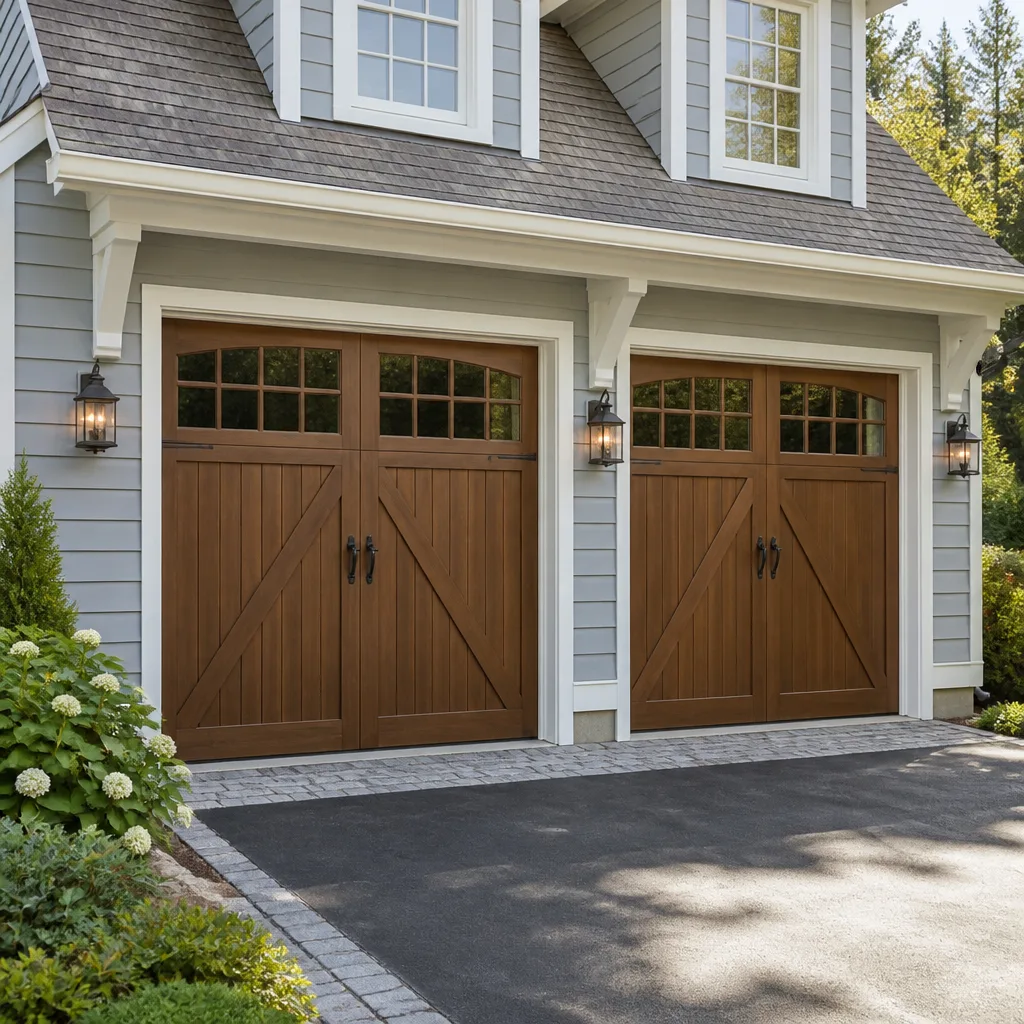 Carriage house
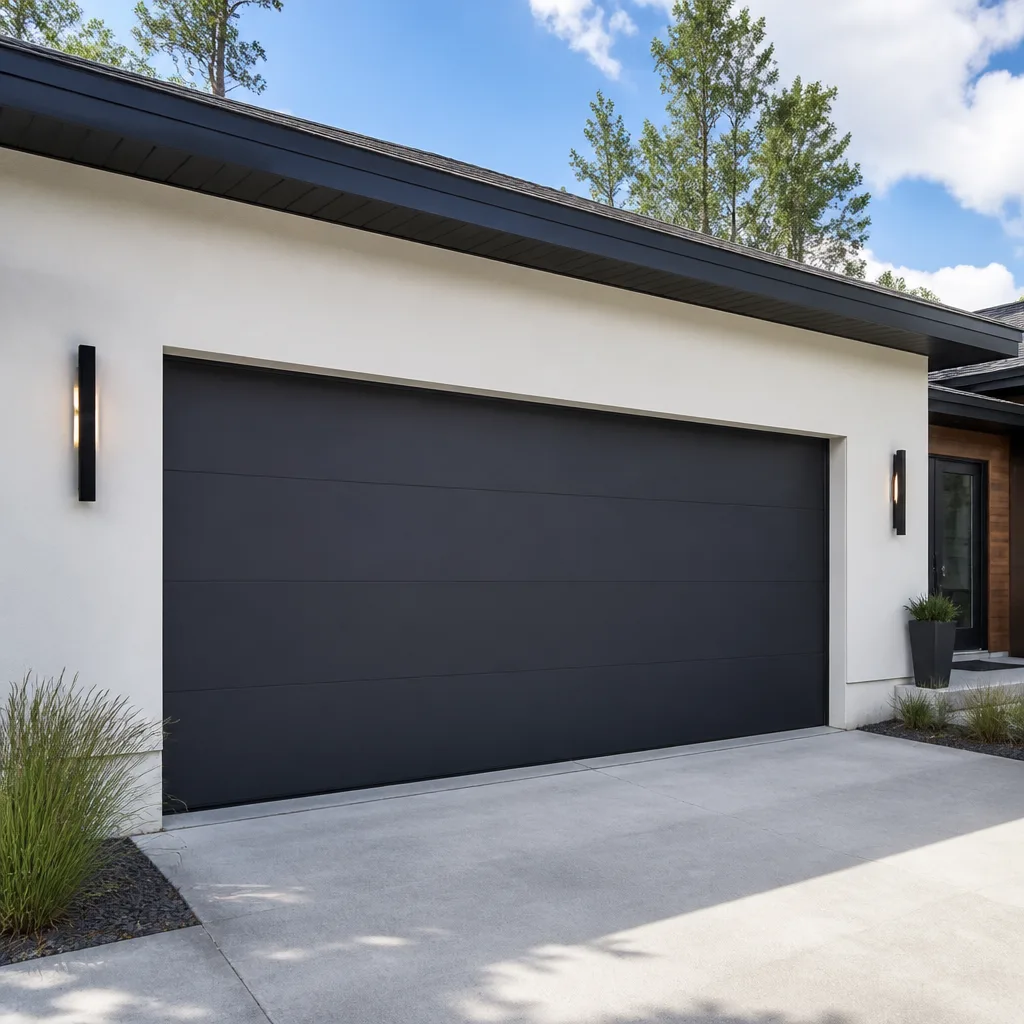 Modern flush
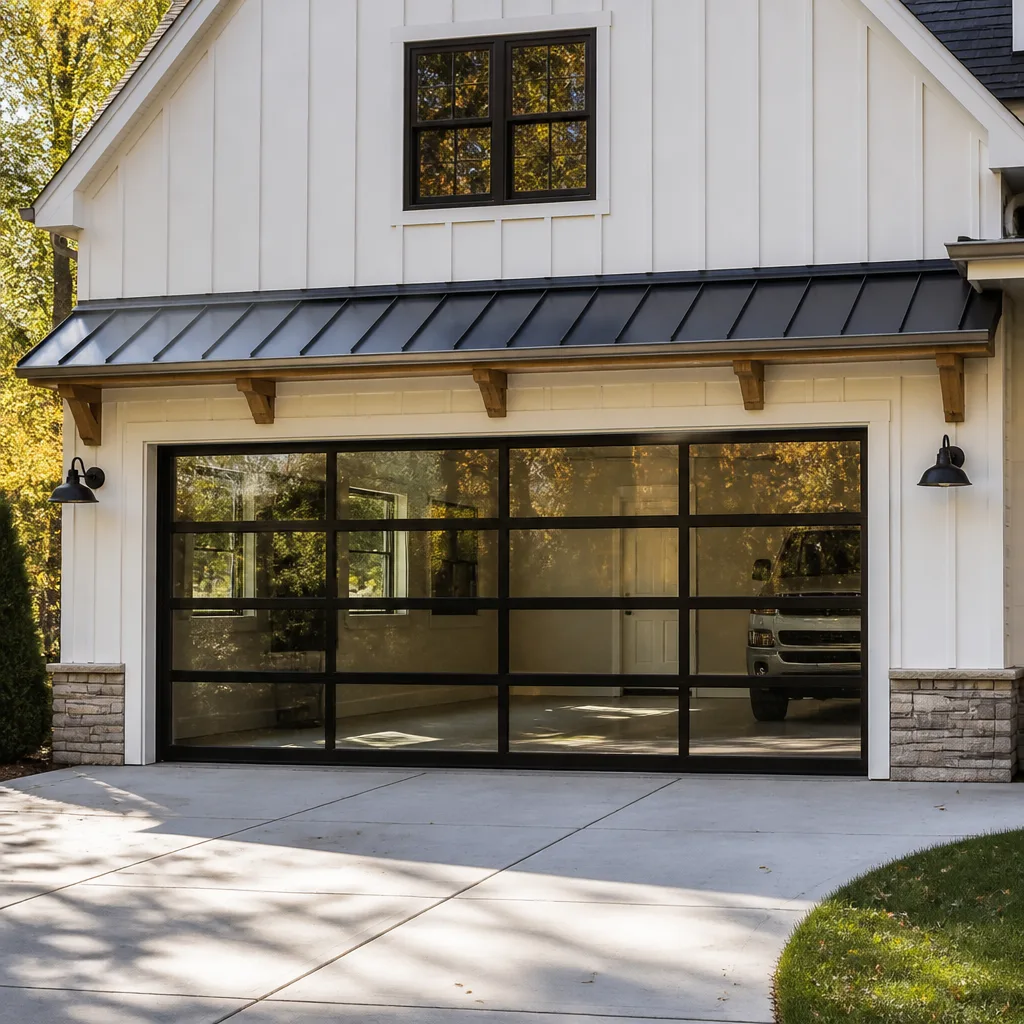 Full-view glass
 LiftMaster openers
 Chamberlain openers
Full 25-point door and opener safety check with every visit - springs, cables, rollers, tracks, and your LiftMaster or Chamberlain opener included
You get a price before we start. It does not change when the truck arrives.
Get your free estimateDIY vs Professional Garage Door: The Jacksonville Homeowner’s Decision Guide
A torsion spring, the large coil mounted above your garage door, stores enough kinetic energy when wound to lift a 150-pound door roughly 10,000 times. Released improperly, that energy can break a wrist, fracture an orbital bone, or worse. That’s not a scare tactic. It’s physics. This guide exists because the DIY-versus-pro debate is usually framed as a money question, but in Jacksonville it’s really a risk-stratification question. The specific repair, your door’s spring configuration, and Florida’s permit requirements determine whether doing it yourself is a reasonable Saturday project or a genuine safety and legal liability. We’ll walk through exactly where that line sits, task by task.
Quick Answer
Most garage door maintenance tasks in Jacksonville are safe for a careful homeowner, including lubricating rollers, tightening bolts, testing safety features, and replacing weatherstripping. When the job involves torsion springs, lift cables, track realignment, or full door replacement, hire a licensed professional. Springs under tension can cause serious injury, and Florida building code requires permits for door replacement that an unlicensed DIY job won’t have at resale. The safe split is roughly: DIY the inspections and simple upkeep, which you can track with a Garage Door Repair Maintenance Checklist for Jacksonville Homeowners. Pro the anything-under-tension, anything-structural, anything-with-a-permit.
Styles & brands we work with
Table of Contents
- The Jacksonville Decision Matrix: What You Can Safely DIY
- Why Your Spring Configuration Determines the Answer
- Florida Permitting and What It Means at Resale
- The True Cost of DIY Failure in Jacksonville
- How to Actually Calculate Your DIY Savings
- Jacksonville-Specific DIY Risks: Humidity, Clay Soil, and Salt Air
- Three Diagnostic Tests Every Homeowner Should Know
- Common Mistakes to Avoid
- When to Call a Professional
- Frequently Asked Questions
The Jacksonville Decision Matrix: What You Can Safely DIY
Let’s split garage door work into three tiers. This isn’t about how handy you are. It’s about what happens when something goes wrong. A stripped bolt is an inconvenience. A released torsion spring is an emergency room visit. In Jacksonville, where a single-family home in Mandarin might have a 16-foot double door and a bungalow in Riverside has a 9-foot single, the tier placement doesn’t change. Only the labor difficulty does.
Tier 1: Owner-Safe Tasks. These are inspection-heavy and tool-light. You can do all of these with a socket set, a level, and a can of white lithium grease, which runs about $12 at any Jacksonville hardware store.
- Photo-eye alignment: The two sensors at the bottom of the door tracks, one on each side, send an invisible beam. If they’re out of alignment, the door reverses on the way down. You can loosen the wing nut, realign the sensors until the indicator lights are steady, and retighten. This is a 15-minute job with a screwdriver.
- Weatherstripping replacement: The rubber seal along the bottom of the door and the vinyl strips along the sides crack in Jacksonville’s UV exposure and heat. Pulling off the old strip and sliding in a replacement is genuinely easy. The part is typically $20 to $45 at retail.
- Remote reprogramming: Your opener’s manual has the exact button sequence. Most LiftMaster, Chamberlain, and Genie openers use a learn button on the motor unit. This takes five minutes and costs nothing.
- Panel dent assessment: You can absolutely determine whether a dent is cosmetic or structural. A dent that doesn’t affect the panel’s rail attachment points is cosmetic. A bend that pulls a hinge from its mounting hole is structural and needs a professional opinion.
- Lubrication: This is genuinely a homeowner task, with one Jacksonville-specific caveat covered later in this guide. In short: use white lithium grease on rollers and hinges. Do not use WD-40 on springs.
Tier 2: Borderline. Pause here. These tasks are physically possible for a homeowner but carry meaningful risk of making things worse or voiding a warranty.
- Roller replacement on the bottom bracket: The bottom roller bracket is attached to the lift cable, which is under full spring tension. Removing that bracket without releasing tension can cause the cable to whip free. If the roller you need to replace is on the bottom bracket, call someone. Top and middle rollers on a standard door are fine to replace yourself, provided the door is in the open position.
- Limit switch adjustments: The limit switch tells the opener where to stop opening and closing. You can turn the adjustment screws on most openers. However, setting the close limit too far can compress the door into the floor and damage the operator. Small turns, one quarter at a time, testing after each.
- Hinge replacement (non-bottom): Center hinges that don’t attach to the spring system or cable are bolt-off, bolt-on. Bottom hinges that attach to the cable must be treated as a Tier 3 item.
Tier 3: Licensed territory. Do not DIY these. Not because you can’t learn how, but because the failure mode is catastrophic and the legal exposure is real. We’ll cover the legal side in the permitting section.
- Torsion spring replacement or repair
- Extension spring replacement
- Any lift cable replacement or adjustment
- Track realignment or replacement
- Full door or opener installation requiring a permit
- Commercial or multi-family door work (separate code requirements in Jacksonville)
This is the structure we use when you call us for garage door repair in Jacksonville. We tell you which tier a repair falls into, and if it’s something you can safely handle yourself, we’ll say so. The phone call is free.
Why Your Spring Configuration Determines the Answer
There are two spring systems on residential garage doors in Jacksonville: torsion and extension. Understanding which one you have is the single fastest way to know whether a repair is DIY-able or not. It’s also the first question any competent technician will ask you over the phone.
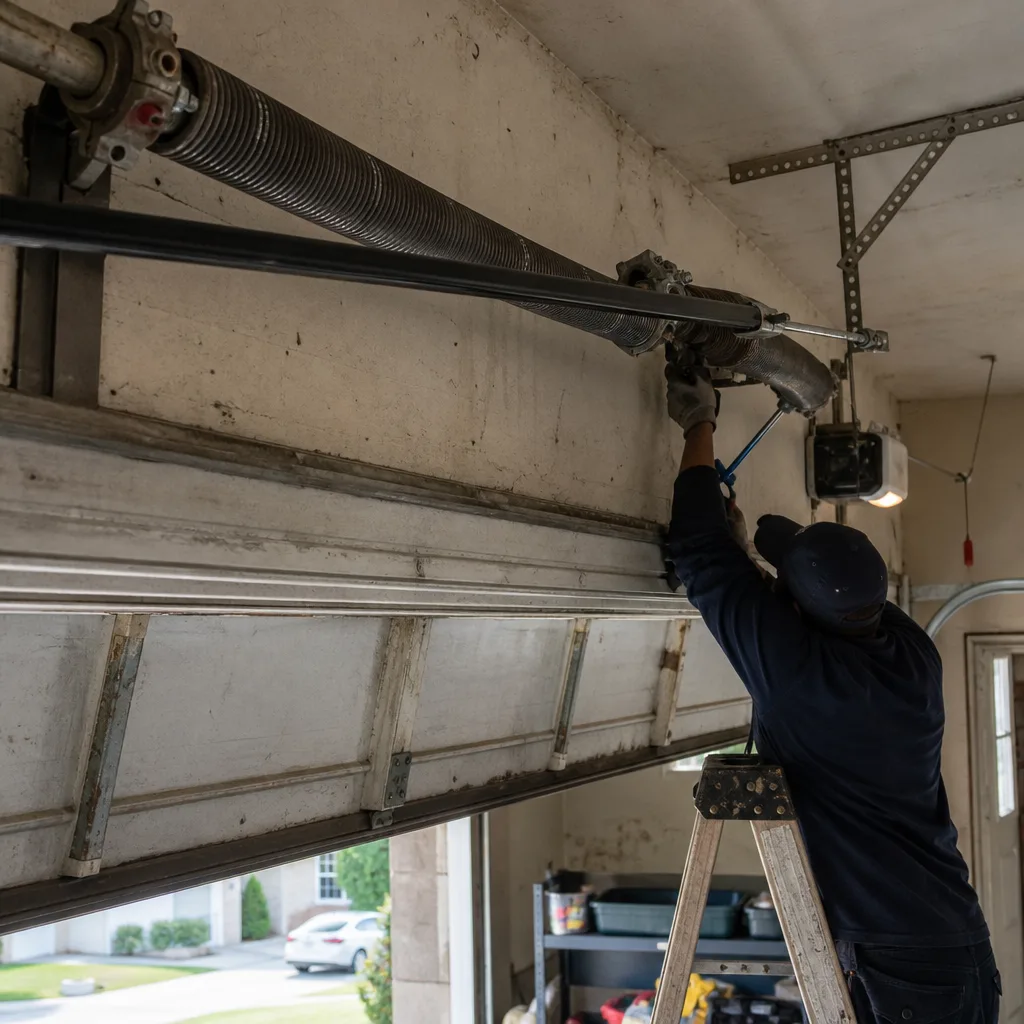
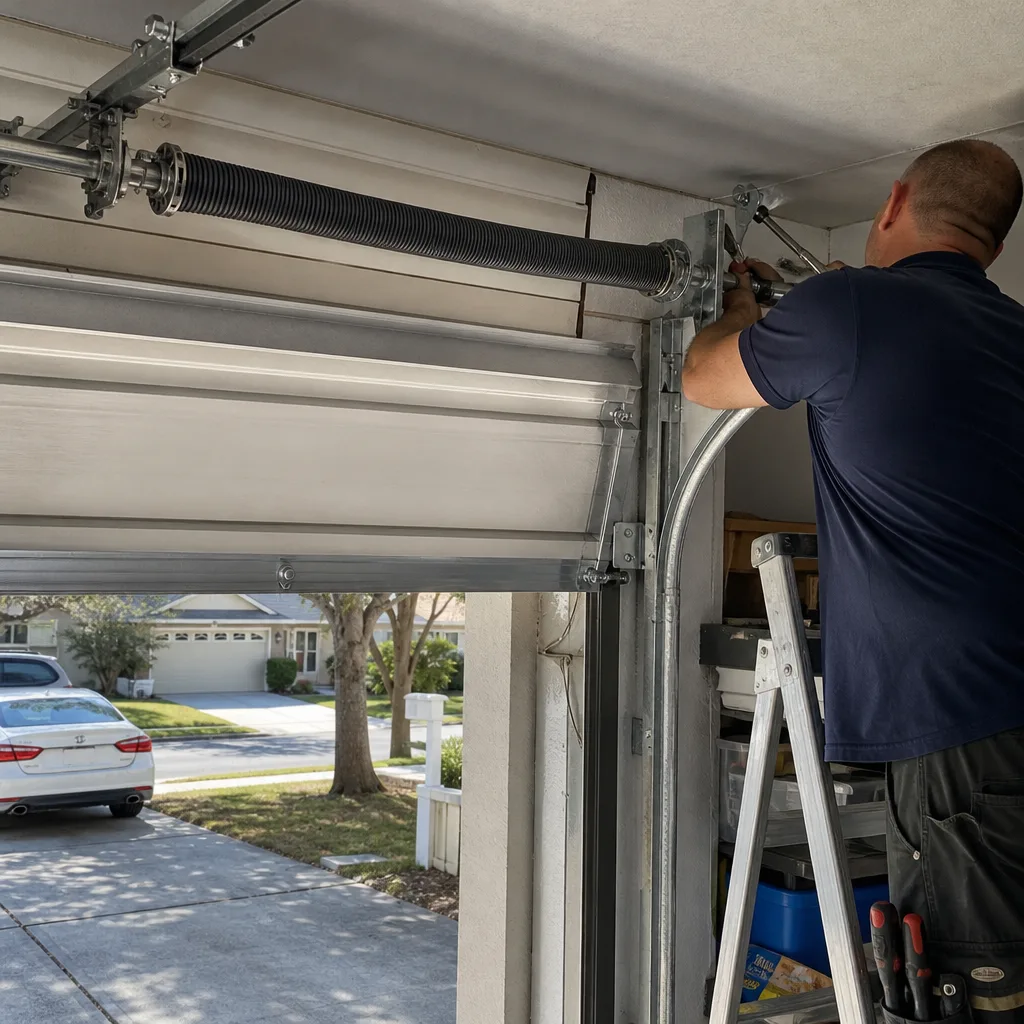
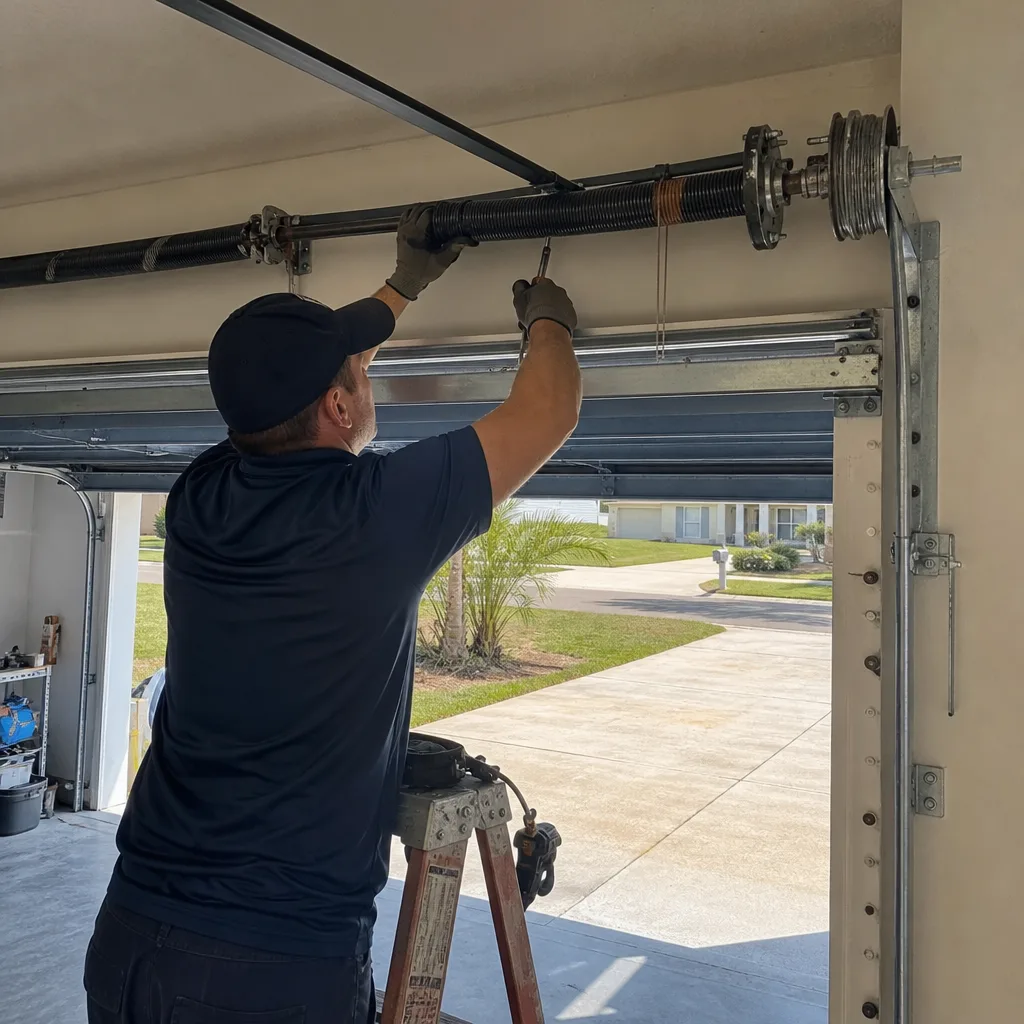
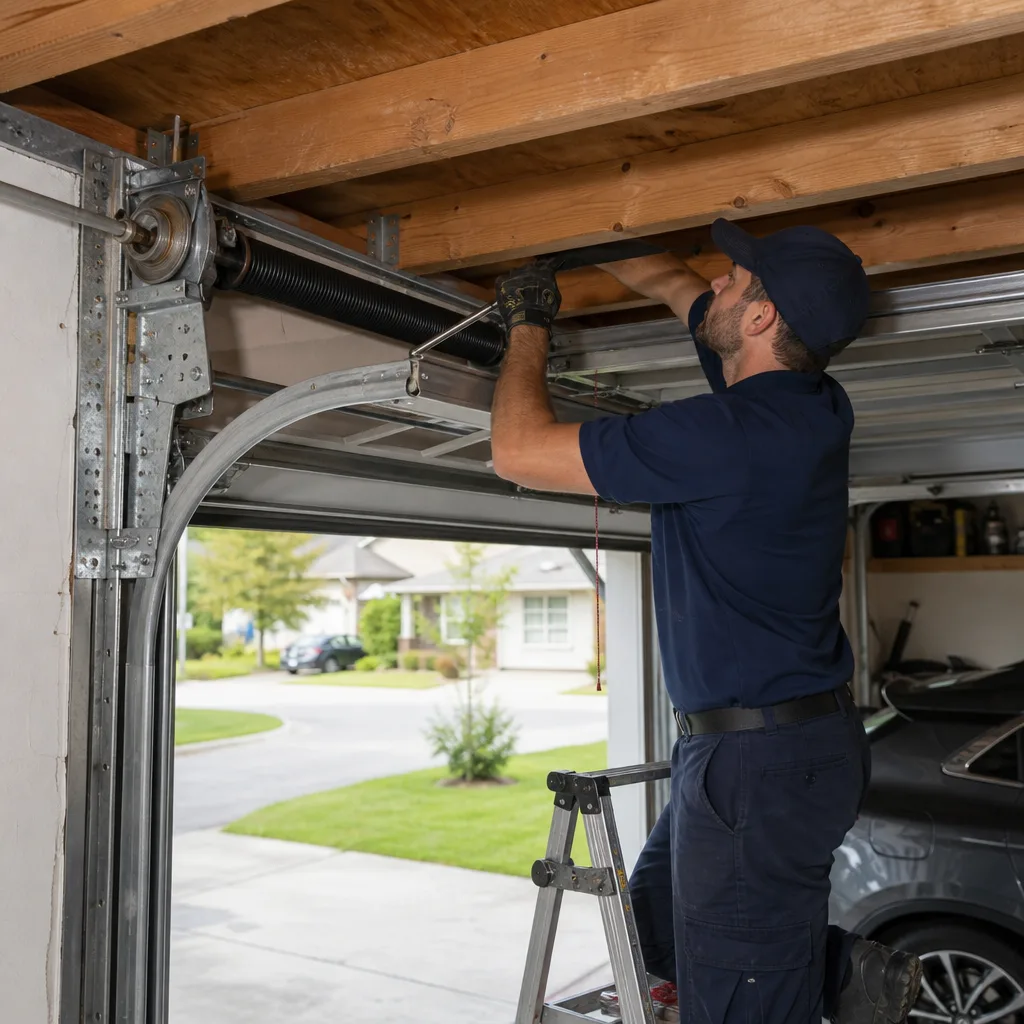
Torsion springs are the thick coils mounted on a metal shaft directly above the closed door, centered on the door opening. They wind under tension. When you turn the winding cone, you’re storing rotational force in the spring. A standard residential torsion spring, when fully wound, holds between 50 and 200 pounds of torque. The winding bars used to adjust them are 18 inches long specifically because a shorter bar gives you less leverage and a longer bar gives you too much. If a winding bar slips out of the cone while under load, it becomes a projectile. In our experience working across Jacksonville, from Ortega to Oceanway, we see more DIY injuries from torsion springs than from any other single cause. Every major spring manufacturer, including Wayne Dalton and Amarr, voids the spring warranty if installation isn’t documented by a licensed professional. That’s not a corporate policy to protect labor revenue. That’s a liability and safety decision.
Extension springs run along the horizontal tracks on either side of the door. They stretch when the door closes. They’re more common on older Jacksonville homes, particularly in neighborhoods like San Marco and Springfield where original garage doors from the 1950s and 1960s are still in service. Extension springs have a safety cable running through the center, which catches the spring if it breaks. If that cable is missing or corroded, a broken spring becomes a missile that follows the line of the track, which is at face height for anyone standing at the side of the door. Extension springs are marginally less dangerous to adjust than torsion, but the cable and pulley system that pairs with them isn’t. We treat extension spring work the same as torsion: Tier 3, professional only.
Here’s what this means for your DIY decision. If your door uses torsion springs, anything involving the spring, the cables, or the center bearing plate is off the table. You can still handle the Tier 1 tasks. If your door uses extension springs, the same rule applies plus one addition: inspect the safety cables every time you change a lightbulb in the garage. If a cable looks frayed or rusted, make the call same day. That’s a repair with a failure mode that can put someone in the hospital.
Florida Permitting and What It Means at Resale
Florida Building Code requires a permit for garage door replacement and, in most Jacksonville code enforcement districts, for new door installation and opener installation when it involves structural or electrical work. Repair, maintenance, and part replacement on an existing door generally do not require a permit. This distinction matters more than most homeowners realize, because it follows the house, not the owner.
Here’s the scenario we see most often in Jacksonville, particularly in Clay and Duval County resale markets. A homeowner replaces their garage door with a self-installed unit they bought from a big-box retailer. The door works fine for five years. They sell the house. The buyer’s inspector pulls the permit history for the property, sees no permit correlated to the door installation, and flags it on the inspection report. Now the seller has three options: hire a contractor to pull an after-the-fact permit, remove and reinstall the door under permit, or negotiate a credit with the buyer. The after-the-fact permit route typically costs between $150 and $450 in permit fees alone, plus the cost of a licensed contractor to stand behind the installation. That’s most of the money they thought they saved by doing it themselves.
There’s also an insurance consideration. If a self-installed door fails and causes property damage or injury, and the installation wasn’t permitted and wasn’t done by a licensed contractor, the homeowner’s insurance carrier may deny the claim. Florida insurers have become considerably more rigorous about this in the past several years, especially after hurricane-driven claims pressure tightened underwriting standards. This isn’t a scare tactic. It’s a risk stratification question, which is exactly how we frame it when a Jacksonville homeowner calls us about garage door installation in Jacksonville. The permit isn’t a bureaucratic formality. It’s documentation that a professional stood behind the work, and it’s a buyer’s protection at resale.
For repairs, the picture is simpler. Spring replacement, cable replacement, roller replacement, opener repair, and sensor realignment are all classified as maintenance. No permit needed. No inspector involved. This is why the repair-versus-replace decision matters for more than just cost. A repair keeps you out of the permitting system entirely. A replacement puts you in it, whether you like it or not.
The True Cost of DIY Failure in Jacksonville
The DIY-versus-pro debate usually starts with the retail price of a part and ends with someone saying, “I’ll just do it myself this weekend,” without consulting a Garage Door Cost Breakdown: The Jacksonville Homeowner’s Reference for 2026. Let’s look at what that actually costs when it goes wrong, which in our experience it does about 40% of the time on Tier 2 and Tier 3 repairs. This isn’t a number from a study. It’s what we observe on service calls where a technician opens the garage door and finds evidence of a previous DIY attempt.
Parts sourcing at retail markup. A torsion spring that a trade professional pays $45 to $90 for at trade pricing costs $90 to $220 at retail from a Jacksonville hardware store or online supplier, if you can find the correct spring at all. Torsion springs are not universal. They’re sized by wire diameter, inside diameter, length, and wind direction. Jacksonville homes with builder-grade doors from the 2000s, particularly in newer developments around Bartram Park and Nocatee, often use door-specific springs that aren’t stocked at retail. So the DIY homeowner orders the wrong spring, waits a week for delivery, installs it, and discovers the door lifts unevenly because the spring rate doesn’t match the door weight. Now they’ve spent more than the professional part cost and the repair still isn’t right.
The service call premium for correcting a failed DIY repair. This is the expense nobody budgets for. When a technician arrives to fix a door after a homeowner attempted the repair, the troubleshooting time is longer. Fasteners are stripped. The wrong parts were installed. In some cases, the door has been thrown further out of adjustment than the original problem. The technician has to undo the DIY work before starting the actual repair. Many Jacksonville garage door companies, ours included, charge a higher service call or additional labor time for correcting DIY attempt damage. That’s not punitive. It’s simply that the job now takes longer. In practical terms, a spring replacement that would have been $280 to $420 on first contact may become $400 to $600 after a DIY attempt has compounded the damage. The homeowner has now spent the retail part cost, plus the pro labor, plus the added correction time. The savings were negative from the start.
Insurance exposure. We covered this in the permitting section, but it bears repeating in the cost context. A DIY repair that fails and damages a vehicle, a wall, or a person is a liability claim waiting for a denial letter. Florida homeowners insurance already runs higher in Jacksonville than in most other Florida metros because of windstorm exposure. Giving your carrier a reason to deny a claim isn’t a risk worth taking for a $200 savings on a spring.
The missed diagnosis cost. The most expensive DIY failure is the one that treats the symptom instead of the cause. A door that’s binding at a particular point in its travel might be a hinge problem. It might also be a track that’s drifted out of alignment because the concrete pad has shifted. Jacksonville’s clay soil expands and contracts with moisture, which is why foundation settling is common in older neighborhoods like Avondale and Murray Hill. If you lubricate and realign a door without addressing the foundation-driven track issue, you haven’t fixed anything. You’ve bought yourself three months of smooth operation before the same binding returns, worse. A professional inspection would have identified the root cause on the first visit.
How to Actually Calculate Your DIY Savings
If you’re going to do a Tier 1 task yourself, let’s calculate the savings honestly, because the honest math almost always favors the DIY approach on Tier 1 tasks, and the dishonest math hides how thin the margin gets on Tier 2 and Tier 3 tasks. Here’s a formula that works for any task.
- List the professional quote. Call a Jacksonville garage door company and ask for a written quote. We’ll give you one over the phone for most common repairs, and we’ll honor it in writing before any work starts. Let’s use a typical example: weatherstripping replacement on a 9-foot single door, quoted by a pro at $95 to $140 including parts and labor.
- List the DIY parts cost. The rubber bottom seal from a Jacksonville hardware store is $22 to $40 depending on the width. The side vinyl strips add another $15 to $25. Total parts: $37 to $65. You’re already saving $30 to $100 off the professional quote, depending on where the pro quoted in the range.
- Add tool cost. For weatherstripping: a pair of scissors and maybe a flathead screwdriver. You already own these. Tool cost: $0. For a photo-eye alignment: a screwdriver, $0. For lubrication: a can of white lithium grease, $12, but you’ll use it on door hinges and car door tracks too, so the amortized cost is maybe $3.
- Add your sourcing time. This is the part everyone forgets. The trip to the hardware store, the wrong part discovery, the second trip, the YouTube refresh. For a homeowner in Jacksonville who lives in Mandarin and shops at the hardware store on San Jose Boulevard, a parts run is 45 to 90 minutes round trip. If you get the wrong part the first time, double it. Value that time at whatever your free time is worth. If it’s $30 an hour, you’ve just spent $45 of time on $60 of parts.
- Add the probability-weighted cost of a mistake. This is the number nobody wants to calculate, but it’s the one that matters. For weatherstripping, the probability of a mistake is low, maybe 10%, and the cost of a mistake is low, maybe a second trip to the store. The probability-weighted cost is about $5. For a photo-eye alignment, the probability of a mistake is maybe 20%, and the cost of a mistake is a door that still doesn’t close, solved by calling the pro anyway. Probability-weighted cost: $20 to $30, which is the portion of the service call you’d pay regardless. For a torsion spring, the probability of a serious mistake is low, maybe 5%, but the cost of that mistake is a $10,000 emergency room deductible and a missed week of work. Probability-weighted cost: $500 to $3,000. The math stops being about savings the moment a spring enters the equation.
Run this math on any task. On Tier 1 tasks, the DIY savings are real, usually $40 to $100, and the risk is trivial. Do it. On Tier 2 tasks, the savings thin out and the risk starts to creep upward. Pause and decide carefully. On Tier 3 tasks, the probability-weighted cost exceeds the DIY savings by an order of magnitude. Call the professional. We’ve run this calculation with homeowners hundreds of times, and the conclusion doesn’t change.
Jacksonville-Specific DIY Risks: Humidity, Clay Soil, and Salt Air
Jacksonville isn’t a generic climate. The garage door advice that works in Phoenix or Denver does not always translate here. Three local factors make DIY garage door work more complicated in Duval County than in most of the country.
Humidity and lubrication. Jacksonville’s average relative humidity hovers around 74%, and in August it sits higher. Humidity accelerates corrosion on bare metal components. This is why the wrong lubricant is worse than no lubricant. Many online DIY guides recommend spraying garage door springs with WD-40 or a generic penetrating oil. WD-40 is a solvent, not a lubricant. It strips away whatever protective film is on the spring, and in Jacksonville’s humidity, that bare metal then corrodes faster than it would have if you’d left it alone. The correct product for garage door springs is either a lithium-based grease or a dedicated garage door lubricant like Genie’s spray lubricant, which is formulated specifically for the high-humidity environments where these doors operate. We’ve seen springs in Jacksonville’s beach communities, from Atlantic Beach to Mayport, where salt air combined with a WD-40 “lubrication” routine turned a 10-year spring into a 4-year spring. That’s a $200 to $400 mistake caused by $7 of wrong product.
Clay soil and track alignment. Jacksonville sits on a mix of sandy loam and clay. The clay zones, particularly in the older pre-war neighborhoods and in parts of the Westside, expand and contract dramatically with seasonal moisture. A concrete garage slab will settle slowly over the years, and a quarter-inch of settling at one corner translates to a visible misalignment in the door tracks above. A homeowner who notices the door binding and decides to realign the tracks themselves is treating a symptom while the foundation keeps moving. Worse, an overcorrection of the track can force the rollers into a bind that accelerates wear on the hinges. The correct approach is to have a professional assess whether the track alignment issue is static or progressive. If it’s progressive, the repair is temporary and the door will need re-shimming every few years. That’s a maintenance plan, not a one-time fix. You won’t know which one you have without lifting the door off its path and observing the play, which is a two-person job with the door in a precarious position.
Salt air in the coastal zones. Jacksonville’s beach communities, from Amelia Island down through Neptune Beach and Jacksonville Beach, live with airborne salt that inland neighborhoods never see. Salt air accelerates corrosion on hinges, rollers, springs, cables, and the metal reinforcement struts on the door itself. A door that looks structurally sound on the exterior may have cable strands corroding inside the sheathing, where you can’t see them until they snap. We recommend that coastal homeowners have their cables and springs inspected at least once a year, not because anything is visibly wrong, but because the failure mode is sudden and dangerous. This is one of the few contexts where a professional inspection is genuinely preventive maintenance, not a sales call.
Three Diagnostic Tests Every Homeowner Should Know
You can gather real diagnostic information before you ever call a technician. These three tests take ten minutes total, require no tools, and give you data to share on the phone call. A knowledgeable Jacksonville homeowner who can say “the door fails the balance test at halfway” gets a much more useful phone conversation than one who says “the door is acting weird.” We ask every caller who contacts us about garage door opener repair in Jacksonville to run these three tests if they can.
- The balance test. Pull the emergency release cord on your opener, the red cord hanging from the trolley. This disconnects the door from the opener. Manually lift the door to knee height and let go. A properly balanced door will hold its position or drift slowly. If it drops hard, the springs are under-tensioned or worn. If it flies upward, the springs are over-tensioned. Either one is a spring issue, not an opener issue, and that distinction saves you from paying for an opener diagnosis you don’t need. Run this test at waist height too. If it holds at one height and drops at another, you may have a track issue rather than a spring issue.
- The force resistance test. With the door disconnected from the opener, open it all the way and pull it closed by hand. You should feel consistent resistance throughout the travel. A door that moves freely for most of its path and then binds at a specific point has a track issue, a roller problem, or a panel alignment issue. Note exactly where the bind occurs: “binds about two feet from the floor” tells a technician a lot. A door that’s stiff throughout the entire travel is usually a lubrication or roller wear issue. Write down what you feel. That’s data.
- The auto-reverse test. Reconnect the door to the opener. Place a 2×4 flat on the floor directly under the door’s path. Close the door. The door should reverse within two seconds of contacting the board. If it doesn’t, the auto-reverse feature is failing. This is a safety feature mandated by federal law since 1993, and a door that doesn’t reverse on contact is a serious hazard, particularly in homes with children or pets. If your door fails this test, stop using the opener and call a professional the same day. This isn’t an adjustment you can safely make yourself on most modern openers, because the force settings interact with the limit switches and the photo-eye system as a group.
Run these three tests, write down the results, and call with data. You’ll get a more accurate over-the-phone diagnosis and a more precise price range. It also protects you from being sold an opener replacement when you need a spring, or a spring when you need a track adjustment. The information is your leverage.
Common Mistakes to Avoid
- Using WD-40 on torsion springs. It strips protective film and accelerates corrosion in Jacksonville humidity. Use lithium grease or a dedicated garage door lubricant. This mistake costs a spring years of service life.
- Replacing a single torsion spring when the door uses two. Both springs have the same cycle life. If one fails, the other is near the end. Replacing one saves $80 to $120 up front and usually costs a second service call within 18 months. Replace both at the same time.
- Removing the bottom roller bracket without releasing tension. The cable is under full spring load. Removing that bracket incorrectly sends the cable whipping and can cause serious hand and facial injuries. If the bottom roller needs replacement, the job is Tier 3.
- Ignoring a failed auto-reverse test. A door that closes on a 2×4 without reversing won’t reverse on a child or a pet either. This federal safety feature exists because people died before it was mandated. If your door fails the test, stop using the opener until it’s repaired.
- Tightening track bolts without checking alignment. Cranking down the mounting bolts on a misaligned track locks the misalignment in place. The correct sequence is align first, then tighten. If you don’t have a level and the patience to shim, call someone who does.
- Buying a replacement opener without checking compatibility. A Genie opener and a LiftMaster wall panel don’t speak the same language. Older Jacksonville homes with original openers from the 1990s may require a conversion kit for a modern replacement to interface with the existing mounting hardware. Check compatibility before you buy, or you’ll make two trips and pay a restocking fee.
- Attempting spring work with improvised tools. The correct tools for torsion spring work are two 18-inch hardened steel winding bars. A pair of screwdrivers, a ratchet extension, or rebar are not substitutes. Improvised bars slip, and a slipping bar under load becomes a projectile. This is the most common direct cause of DIY garage door injuries we hear about.
When to Call a Professional
Call a professional when the repair involves torsion springs, extension springs, lift cables, bottom rollers, track realignment, or any door replacement that requires a permit. Call a professional when the door fails the auto-reverse test, when it drops hard on the balance test, or when you hear a bang from the garage and find a spring broken. Call a professional when you’ve attempted a Tier 2 repair and the door still isn’t right. Doyle Garage Doors Jacksonville offers free estimates in Jacksonville. We answer the phone 24/7, including weekends and holidays, and the person who picks up knows garage doors. Call (904) 549-9535 and you’ll talk to a real person, not a voicemail tree.
Frequently Asked Questions
You can physically purchase a torsion spring at retail in Jacksonville, but you should not install it yourself. Torsion springs are under 50 to 200 pounds of torque, and the winding bars can become projectiles if they slip. Every major spring manufacturer voids the warranty on self-installed springs, and Florida homeowners insurance may deny a claim if an unlicensed self-install leads to an injury. A professional spring replacement in Jacksonville typically runs $280 to $420 per spring, and the cost includes the warranty and the safety of not being in the room when the spring is wound. Call (904) 549-9535 for an exact quote on your specific door.
Garage door repair in Jacksonville ranges from $95 to $140 for minor work like weatherstripping and sensor alignment, $150 to $300 for roller and hinge replacement, and $280 to $420 per torsion spring for spring replacement. Opener repair typically runs $120 to $250 for circuit board, limit switch, or gear replacement. Full door replacement with a mid-range Clopay or Amarr door typically starts around $1,100 to $1,800 including installation for a standard 9×7 door, before any permit fees. All of these prices should be quoted in writing before any work starts.
Yes, in most Duval County jurisdictions, garage door replacement requires a building permit because the door is part of the building envelope. Repair and maintenance on an existing door, including spring replacement, cable replacement, and opener repair, does not require a permit. If you sell your home and the door was replaced without a permit, the buyer’s inspection may flag it, and you’ll be responsible for the after-the-fact permitting or a negotiated credit.
Standard torsion springs are rated for approximately 10,000 cycles, which translates to 7 to 10 years for most Jacksonville homeowners who open and close their door 3 to 4 times daily. Coastal homes in Jacksonville Beach and Atlantic Beach may see shorter lifespans, 5 to 7 years, because salt air accelerates corrosion. If you know your door’s spring cycle rating and want to extend spring life, keeping the springs lubricated with the correct lithium grease is the single most effective maintenance step.
Most modern openers have surge protection that may have tripped during a Jacksonville thunderstorm, which means the unit needs a reset rather than a replacement. Unplug the opener for 30 seconds, plug it back in, and test. If the wall panel still shows no power and the breaker is fine, the circuit board likely took a surge. A replacement board typically costs $120 to $250 installed, which is often less than a full opener replacement. However, if the opener is more than 12 years old, replacement may be more cost-effective. Call (904) 549-9535 and describe the symptoms. We can often diagnose the issue over the phone.
A door that rises unevenly usually has a broken spring on one side, a broken cable, or a track that’s drifted out of alignment due to foundation settling on Jacksonville’s clay soil. Stop using the door immediately, because continued operation will compound the damage. Run the balance test described above if you can safely do so. Then call a professional. A crooked door is rarely a one-part fix, and treating it as a simple realignment problem often masks a worsening track or foundation issue. Call (904) 549-9535 for a free assessment.
The Bottom Line
The DIY-versus-pro decision in Jacksonville comes down to failure modes, not just dollar amounts. Weatherstripping, lubrication, sensor alignment, and remote programming are owner-safe tasks that save you $40 to $100 and are worth doing yourself. Springs, cables, bottom rollers, track work, and any door replacement cross into territory where the downside risk of a mistake outweighs the savings by a factor of ten or more. Throw in Florida’s permitting requirements, Jacksonville’s humidity and clay soil, and the manufacturer warranty void on self-installed springs, and the line becomes clear. Inspect freely. Repair carefully. Replace professionally. And when in doubt, call a professional in Jacksonville. You’ll get a straight answer and a written price before anything is touched.
Written by Aaron Teague, Owner at Doyle Garage Doors Jacksonville, serving Jacksonville since 2001.
See the difference
 Before
 After
After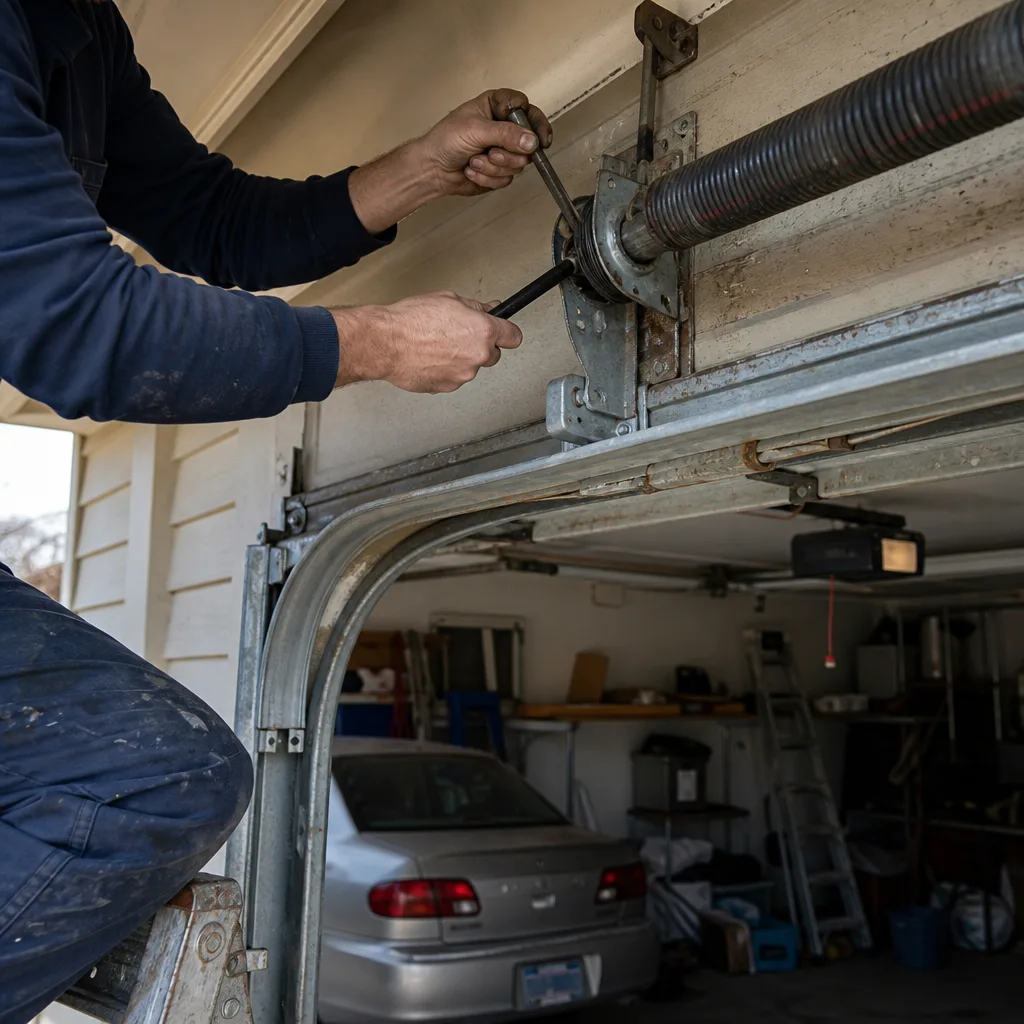 Before
 After
After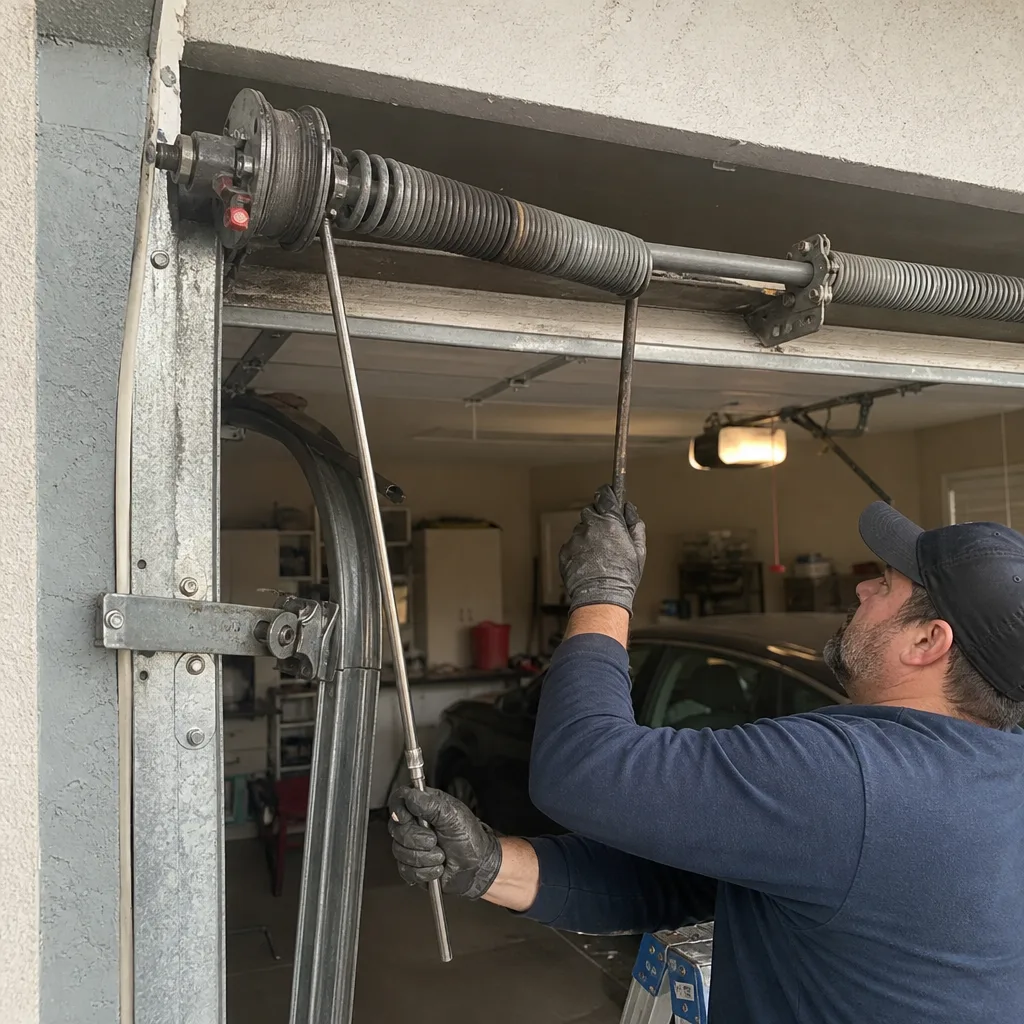 Before
 After
After